Pulse November 2026
By Paul Asadoorian & Chase Snyder
php2shell puts PHP flaws php2shell is now exploited on firewalls; Cisco Expressway joined the CISA’s known-exploited list on November 20, and most of this month’s exploited flaws exposed appliances through shared codeonly the vendor can fix inside network edge appliances, and ten advisories fix flaws attackers were already exploiting
By the Numbers
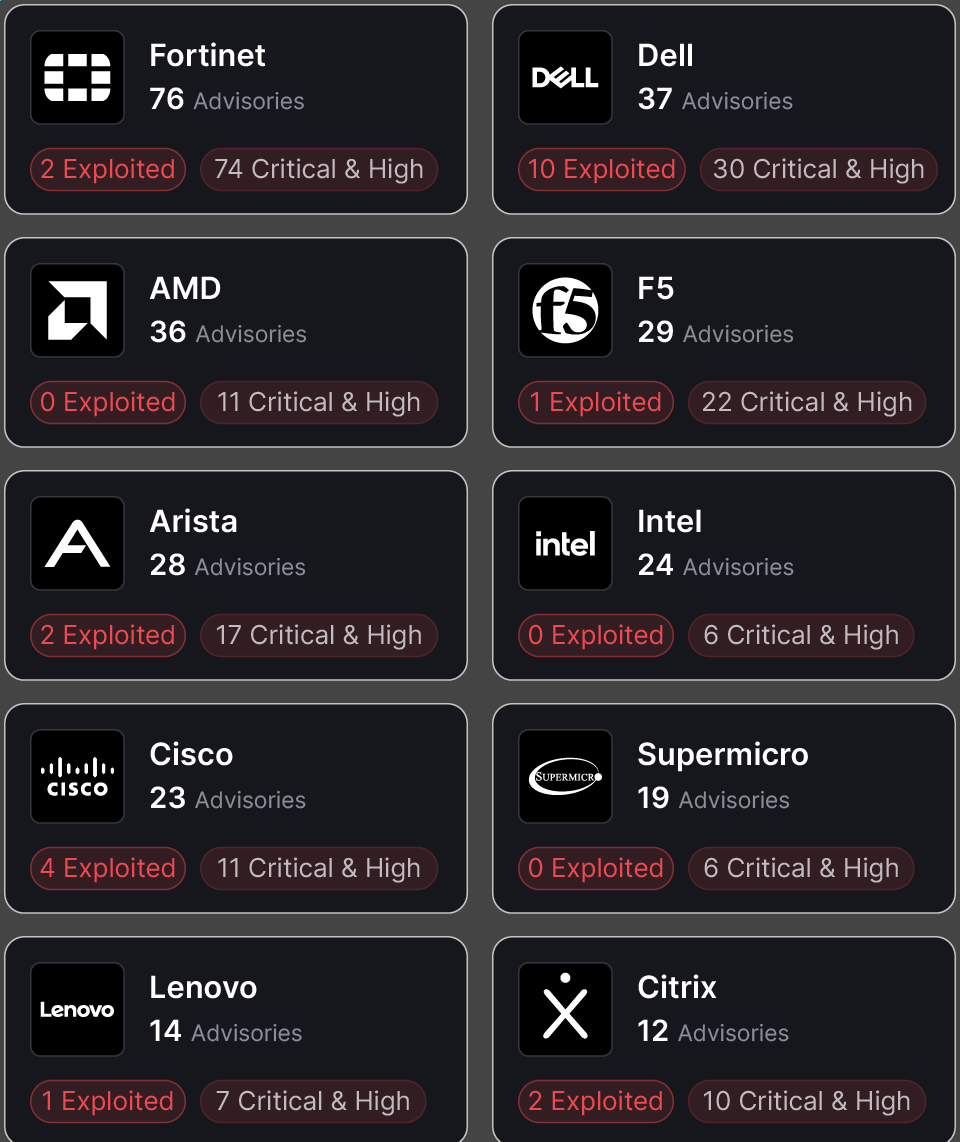
InfraTrust Pulse is our monthly rundown of security advisories for infrastructure hardware including network devices, servers, user endpoints, chips, firmware, and components such as baseboard management controllers (BMCs). From October 15 through November 19, 2026, we tracked 373 new advisories from 23 vendors. Ninety-eight are rated Critical (CVSS score of 9.0 or above), and 38 include a CVE listed in the CISA KEV list.
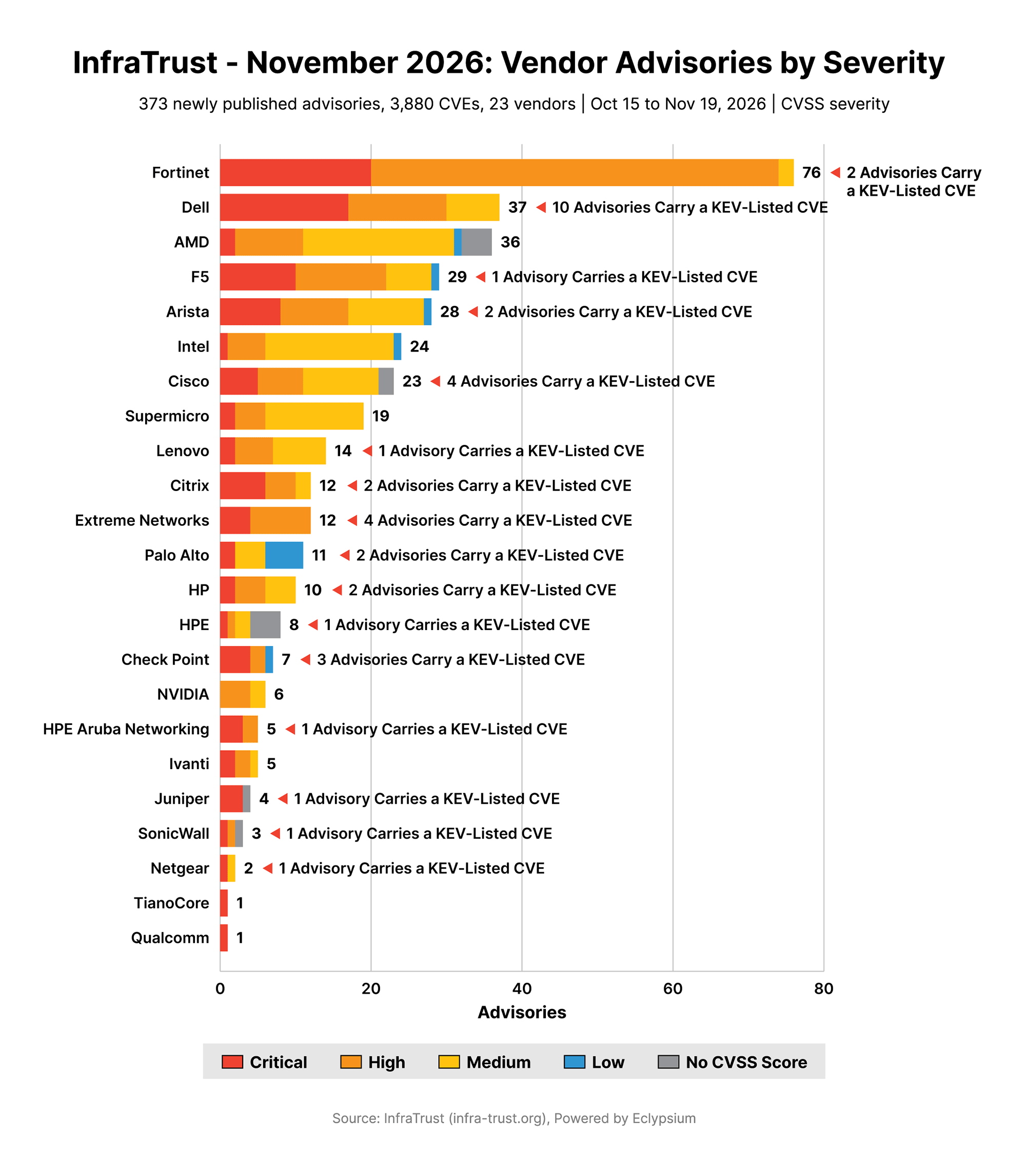
Based on this month’s data, here’s a summary of what security and IT teams should be focused on:
- Patch Cisco Expressway clusters to X15.5.20 (CVE-2026-76466), confirm the php2shell fixes on every Palo Alto Networks PAN-OS and Check Point device, then work down the Now items in What to patch first.
- Examine any PAN-OS firewall or Check Point gateway that was reachable from the internet before it was patched. The PHP2SHELL fix does not remove a webshell or backdoor already planted.
- Move management interfaces off the internet and segment them internally, and budget a second appliance patch cycle for the PHP fixes published on November 19.
- Track exposure by component (PHP, Node.js, Java, OpenSSH, and server firmware), because 33 of the 38 advisories with an exploited CVE include component code the vendor bundled, not code the vendor wrote.
November 2026 Analysis
Supply chain vulnerabilities leave enterprises minding the gap
Most exploited infrastructure vulnerabilities this month came from bundled components in the supply chain rather than vendor code, leaving enterprises exposed while each fix works its way downstream. Palo Alto Networks waited for the PHP project to patch php2shell; its customers waited for Palo Alto, then had to roll out the fix. Meanwhile, Fortinet’s chief information security officer warned that attackers can use artificial intelligence (AI) tools to turn a published fix into a working exploit within hours or days.
php2shell reached firewalls
php2shell, the pair of PHP flaws (CVE-2026-109618 and CVE-2026-109619) that led our October edition, is now being exploited against firewalls. On PAN-OS, attackers hit internet-facing management interfaces and chained it with a Linux kernel flaw, Fragnesia (CVE-2026-46300), to become root, starting October 23, according to Dream Research, two days before Palo Alto’s first hotfix. Check Point says attackers hit its Mobile Access Portal a week after its first hotfix, then used CVE-2026-123039 to become root, with destructive activity in some cases. Treat any device that was exposed and patched late as possibly compromised until someone checks it.
| Status on November 20 | Vendor advisories | What to do |
| Fixed, and exploited | Palo Alto Networks (CVE-2026-109618 advisory), Check Point (sk1000302) | Install the hotfix, then check exposed devices for compromise. |
| Fixed | F5 (K000163821), NetScaler (CTX697263), Cisco (cisco-sa-php-october26-Jj384Daq), QNAP (QSA-26-18), HPE Aruba Networking (HPESBNW05171), Extreme Networks (SA-2026-194), Dell (DSA-2026-475, DSA-2026-504) | Install the fix. |
| Partly fixed, or no fix yet | Fortinet (FG-IR-26-186), Juniper (JSA112681), Lenovo (LEN-233228), HPE (HPESBGN05174), Netgear (PSV-000070960), HP (HPSBHF04160), Siemens (SSA-166980) | Restrict management access and track each advisory. |
| Not affected | SonicWall (product notice), Arista (Security Advisory 0200), Supermicro, Sophos, WatchGuard | None for listed products. |
| No statement | Ivanti | Ask Ivanti directly. |
PHP published another 18 advisories on November 19, seven rated Critical. One of them, phpAfterShell (CVE-2026-126714), affects the F5 BIG-IP Configuration utility with no fix yet (K000164320), so limit who can reach it. The other five vulnerabilities hit the supply chain hard, keeping Linux distributions, firewall vendors, and anyone who maintains Linux servers or Linux-based appliances on their toes:
| Flaw | Where it is and where fixes stand | What to do |
| Node2Shell (CVE-2026-111497) | Google’s Brotli library in Node.js. On the KEV list. Fixed by Palo Alto Networks, Arista, Check Point, Citrix and Extreme Networks. Cisco lists some fixes reaching into 2027. | Install fixes; restrict access where no fix is available. |
| SSHole (CVE-2026-123158) | OpenSSH built on the musl C library. On the KEV list. No tracked vendor names an affected product. | Update your own musl-based systems, such as Alpine Linux, to OpenSSH 10.6p2. |
| Java4Shell (CVE-2026-114938) | Java runtime on some newer x86 processors. F5 BIG-IP 21.1.0 is affected with no fix (K000164290). | Limit administrator access to affected BIG-IP systems. |
| Linux kernel flaw (CVE-2026-98432) | Critical, CVSS 9.8. Fixed in Junos OS Evolved (JSA119568). | Apply vendors’ kernel updates. |
| EDK II network boot flaw (CVE-2026-97631) | Server firmware. Supermicro has most fixes, Lenovo targets run to June 2027, and Dell, HP and Intel have published nothing. | Turn off network boot where unused. |
Incident responders checking exposed PAN-OS and Check Point devices should hunt back to October 17, the first attempt Amazon recorded. Look for a webshell at /unauth/php/change_password.php on PAN-OS, and on Check Point for PHP session files containing upload_progress_pwn and unusual commands in /var/log/dynamicCli.log.
Of the 38 advisories with a KEV-listed CVE, only five fix a flaw in the vendor’s own code. The other 33 carry the exploited flaw in a bundled component, most often php2shell, Node2Shell, or SSHole. This highlights the need for supply chain visibility through SBOMs, HBOMs, and FBOMs.
Nginx2root Impacts Network Infrastructure
Continuing the theme of bundled open-source software introducing critical vulnerabilities into network hardware, F5 disclosed five nginx vulnerabilities, collectively dubbed nginx2root, on November 18, 2026. Palo Alto Networks has since confirmed that several releases of PAN-OS, along with Panorama, are affected when HTTP/2 is enabled. The flaws allow an unauthenticated remote attacker to crash an nginx worker process or execute code as that worker. Cisco’s advisory covers all five and lists NX-OS on standalone Nexus 3000 and 9000 switches as affected, with a fix expected in December. Cisco’s Secure Firewall products are not affected, and IOS XE and IOS XR are still under investigation. Fortinet says FortiOS is not affected (FG-IR-26-279), F5 says the same for BIG-IP (K000163926), and Juniper and Arista have not published advisories.
None of the five vulnerabilities were in the CISA KEV as of November 24, and Palo Alto and Cisco say they know of no malicious use. Rapid7 has published a proof-of-concept exploit for CVE-2026-123007. PAN-OS administrators with HTTP/2 enabled should upgrade to the fixed build for their release or turn HTTP/2 off until they can, and teams running NX-OS on Nexus switches should watch Cisco’s advisory for the fixed release.
Your exposure to supply chain vulnerabilities depends on how quickly each vendor rebuilds its products after an upstream fix ships. Ask appliance vendors for the open-source components and versions in each release, write component patch timelines into renewals where you can, and track exposure by component so the next vulnerability doesn’t become a vendor-by-vendor scramble.
Fortinet’s AI-assisted Vulnerability Discovery
On November 10, Fortinet published 89 advisories, 19 rated Critical, and credits frontier AI models in 82 of them, 80 naming Anthropic’s Claude Mythos. None is known to be exploited. The fixes shipped in October hardening builds that Fortinet announced on October 21 while holding back details. Most of the advisories cover FortiManager, FortiAnalyzer, and FortiMail, including flaws that need no credentials, such as FG-IR-26-274 and FG-IR-26-275, each rated Critical, CVSS 9.8.
If you have not installed the October builds, do it now, starting with those three products, and limit which systems can reach their management and log-receiving ports. Treat a vendor hardening release as a security update when the vendor says details will follow; it’s a rare chance for you, the defender, to patch vulnerabilities before threat actors reverse engineer a patch and create working exploits.
AI infrastructure vulnerabilities
CISA now lists two open-source AI tools as exploited: GPUStack, which runs models across graphics processing unit (GPU) clusters (CVE-2026-102895, Critical, CVSS 9.8, fixed in 2.2.0), and the LiteLLM model gateway (CVE-2026-40217, fixed in 1.83.11). NVIDIA’s bulletin 5912 fixes a missing-authentication flaw in the NeMo Agent Toolkit rated a perfect 10.0 (CVE-2026-65145, fixed in 1.9.0). Confirm which team owns these tools in your environment, patch them, and keep their administrative interfaces off the internet.
What to Patch First
Here’s a prioritized list of the order in which we would patch this month’s critical and high vulnerabilities. Start with items marked “Now.” Within each priority, patch internet-facing management or remote access devices first.
| Priority | Product | Flaw | Fix |
| Now | Cisco Expressway-C and Expressway-E clusters | CVE-2026-76466, Critical, CVSS 9.8 | X15.5.20 (cisco-sa-vcs-static-cred-hr7EWZ8t) |
| Now | PAN-OS and Check Point gateways | php2shell and CVE-2026-123039 | See PAN-OS table above |
| Now | Arista VeloCloud Orchestrator | CVE-2026-114625, Critical, CVSS 9.9 | Security Advisory 0199 |
| Now | Cisco Secure Firewall Adaptive Security Appliance and Firewall Threat Defense with remote access virtual private network (VPN) | CVE-2026-76418, High, CVSS 8.6 | cisco-sa-asaftd-tunnel-dos-s6mgkb75 |
| Now | SonicWall SonicOS VPN with single sign-on | CVE-2026-19868, High, CVSS 7.1, skips multifactor authentication | SNWLID-2026-0014 |
| Next | Node2Shell appliances, and Dell storage and backup products | CVE-2026-111497; older exploited flaws in DSA-2026-476 and DSA-2026-474 | Vendor updates |
| This cycle | Fortinet FortiManager, FortiAnalyzer, FortiMail | CVE-2026-126261 and others, up to CVSS 9.8 | October hardening builds |
| This cycle | HPE Aruba AOS-8 and AOS-10, Supermicro BMC firmware, Citrix NetScaler, F5 BIG-IP Access Policy Manager | CVE-2026-79846, CVE-2026-18450, CVE-2026-107412, CVE-2026-123637, all Critical, not known exploited | Vendor fixes |
Side notes on two vendors:
- Cisco Expressway. Cisco’s advisory says it knows of no malicious use, but F6 reported attackers rooting internet-facing nodes and then internal cluster nodes. Check every cluster node for compromise.
- Check Point. sk1000362 has no fix for R81.10 or R81; both are past end of support, so gateways on those versions need an upgrade plan this month.
Security Hygiene and Compensating Controls Are More Urgent Than Ever
The entire technology industry is undergoing an enormous recalibration in the face of AI-driven vulnerability discovery and exploit development. Enterprises have no control over how many patches their vendors will ship, or how many vulnerabilities will be exploited. Vulnerabilities are exploited almost as soon as they’re disclosed or even beforehand in many cases. That means the exposure gap between when a vulnerability is exploited and when you can patch it is increasing.
To stay secure under these circumstances, security hygiene, compensating controls, and threat hunting are more important than ever. Get your management interfaces off the public internet. Segment them internally to limit lateral movement. Learn how to hunt for implants and backdoors left behind on your network appliances even after you patch. Patching is table stakes, but what you do before the patch is available and after the exploit hits will determine whether you survive.
Frequently Asked Questions
A monthly rundown of infrastructure security advisories, with counts from InfraTrust.
Cisco Expressway clusters, then the php2shell fixes and CVE-2026-123039 on PAN-OS and Check Point, then the other Now items in What to patch first.
Not if the device was reachable from the internet before you patched. Look for compromise, and plan for PHP’s November 19 fixes, including phpAfterShell (CVE-2026-126714).
It tested its products with frontier AI models. The fixes shipped in October and the details on November 10.
Only on newer x86 processors. Nobody reports exploitation of CVE-2026-114938 yet.
Supermicro has most fixes, Lenovo’s run into 2027. Disable unused network boot.
Sources
- Data: infra-trust.org and CISA’s Known Exploited Vulnerabilities catalog
- php2shell: Unit 42, Dream Research, Check Point Research
- Shared flaws: Node.js, Calif, GreyNoise, Anthropic’s Frontier Red Team, and TianoCore GHSA-99cj-7hg9-mp4m